
Announcing the ICML 2026 Tutorials
By ICML 2026 Tutorial Chairs Claire Vernade and Adam White.
Tutorials are a critical part of the conference experience. They provide graduate students the opportunity to learn in depth from topic experts. They provide practitioners and theoreticians the ability to learn foundational background and the dark-arts of how to get things working in practice. With our growing community, tutorials can often provide a much needed smaller community to connect with.
With this rapid growth comes challenges. A huge diversity of topics. A large number of proposed tutorial submissions. At the same time we want to channel the community’s inputs, while relying on non-artificial evaluation of submitted proposals. In this post, we outline the review process we used for this year’s tutorials and formally announce the selected tutorials.
This year’s process
This year we used a three-pronged approach. We wanted some invited tutorials, suggestions from the community, and a rigorous review process. In late December we reached out and confirmed three invited tutorial presenters:
- Is numerical optimization theory irrelevant to machine learning practice in 2026?
- Mark Schmidt (UBC)
- Probabilistic Numerics — Computation is Machine Learning
- Philipp Hennig, Marvin Pförtner, Tim Weiland (U Tübingen)
- Calibration: From Predictions to Decisions, Collaboration, and Alignment
- Aaron Roth, Natalie Collina (UPenn)
After we confirmed these speakers, we reached out to the ICML community to solicit nominations for both topic suggestions and members of the community to deliver tutorials. We received 118 suggestions from a health diversity of folks from undergraduates all the way to industry professionals:
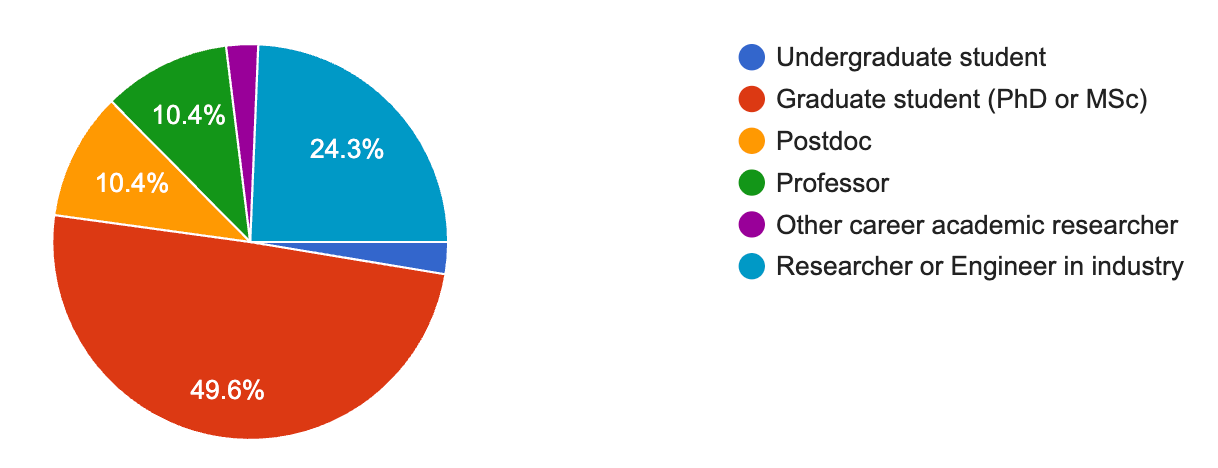
From these initial seeds, we created a call for proposals. We distilled the community suggestions into six suggested topics (as well as “Other,” of course):
- Beyond-Transformer sequence models (state-space, S4, etc.)
- Deep Learning and Deep RL Theory and Applications
- Diffusion models – quantitative & theoretical understanding
- LLM post-training and test-time training
- Safety, machine unlearning, watermarking, and fingerprinting
- Theorem proving and Lean
We also reach out to 14 individuals, personally inviting them to submit a proposal, as they were nominated by the community in phase two.
The call resulted in 52 submissions! All proposals were evaluated in the same way, even if they were invited. Both chairs independently reviewed and read every single proposal and made a short list for each of the 7 topic areas (including “Other”). In the final calibration, both chairs agreed almost unanimously on all topic areas. The main criteria used were: 1) quality of proposal, 2) established topic expertise by presenters, and 3) teaching experience. The latter did not exclude industry researchers but required folks to explain their teaching experience.
In the end, we selected an additional seven tutorials for ICML 2026 (making a total of ten) and we are thrilled to announce them below. All tutorials will take place on the first day of the conference, Monday July 6.
- Proving Theorems with Lean and Machine Learning
- Evaluating and Training LLMs for Math Copilots and Theorem Proving
- Simon Frieder, Philip Vonderlind
- Adaptive Reasoning in LLMs: From Post-Training to Test-Time Learning
- New Techniques for Sequence Prediction: Spectral Filtering and Preconditioning
- Unifying Attention and Diffusion with Kan Extension Transformers: Structured Deep Learning with Diagrammatic Backpropagation
- Unlearning Data at Scale
- Diffusion and Flow-Matching: From Memorization to Generalization & Beyond